Field note
From ShapesXR to WorldAgents
ShapesXR helped spatial teams design, prototype, and validate immersive products before production. WorldAgents carries that same principle into AI agents that need to operate in real places.
Field note
ShapesXR helped spatial teams design, prototype, and validate immersive products before production. WorldAgents carries that same principle into AI agents that need to operate in real places.
The shift
ShapesXR was built around a simple idea: spatial work should be reviewed spatially. Teams designing for XR, smart glasses, immersive interfaces, events, training, and real-world 3D need to understand scale and context early.
WorldAgents starts from a related problem. AI agents are leaving the chat window and entering stores, warehouses, venues, campuses, and field work. They need to understand the place, the workflow, the user's current situation, and the device being used.
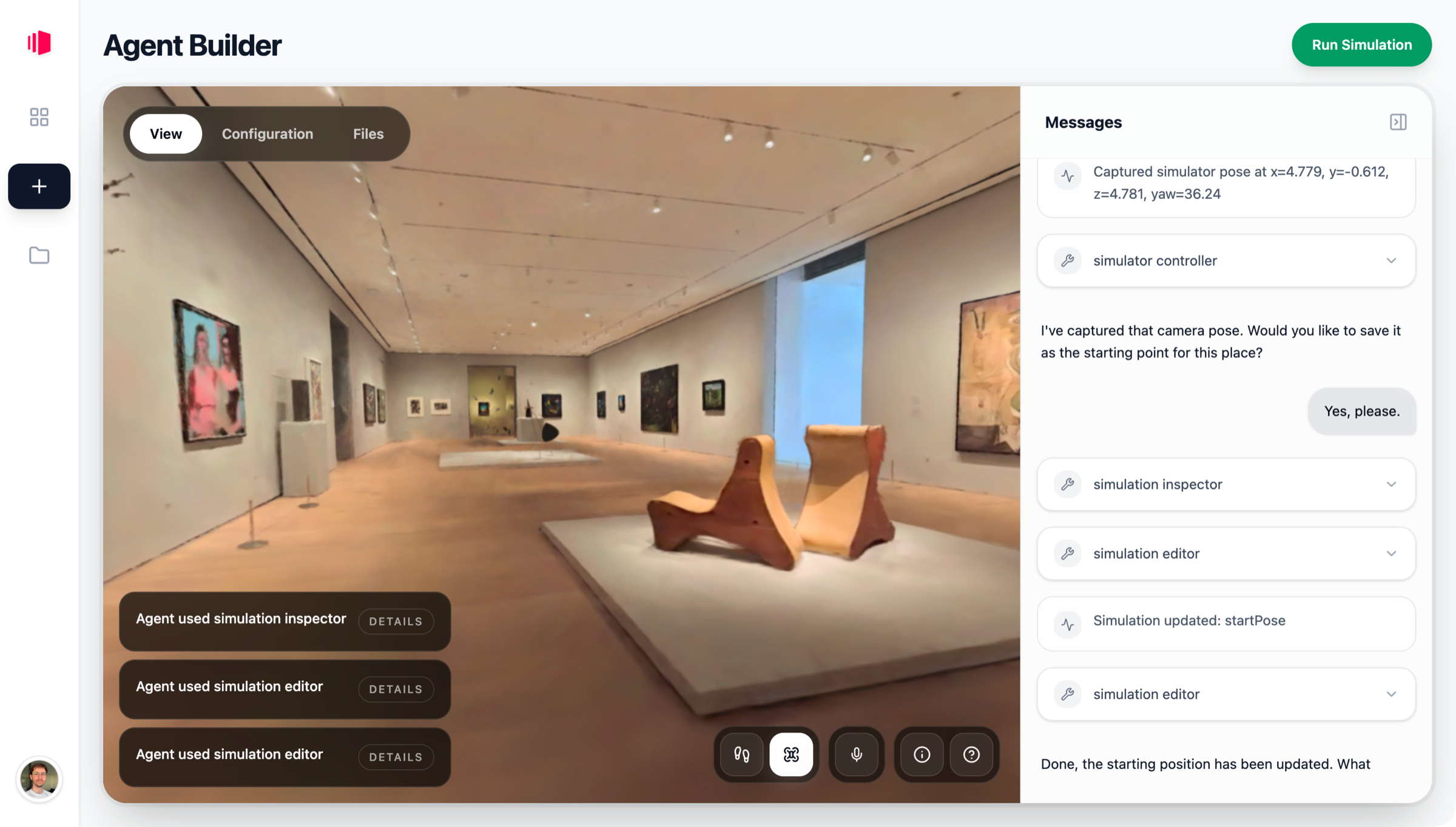
That is why WorldAgents is built around simulation and the Spatial Intelligence Engine. The goal is to test the agent in context before it becomes part of an operational workflow.
Trusted by teams using ShapesXR







Spatial Design Lead, PICO
"Reviewing MR/VR/AR designs at a 1:1 scale is vital. ShapesXR, with its in-headset multiplayer editing and Unity export plugin, has significantly revolutionized my design firmly establishing itself as a leader in XR design."


Sr. UX/UI Designer, TRIPP
"In VR I can whip up 10 variations of a spatial AR interface in 10 minutes without problems. ShapesXR is miles ahead of everything from flow perspective. On a desktop, you waste so much time and regressing back to 3D desktop tools is not an option for me."


Principal Designer, Adobe
"The only way to really grapple with spatial design concepts such as UI positioning in 3D, contextual anchoring, and managing user attention, is to use apps like ShapesXR where you can very quickly mock this up and get an early understanding of how things look and feel spatially."


CTO & Co-Founder, Nanome
"We are all stoked to have ShapesXR as a XR design tool now and it’s something that would have completely changed how we went about building our app if we have had it since the beginning of the company back in 2015."


Head of Design AR/VR, Logitech
"ShapesXR allows us to quickly create fully immersive scenes and populate these with key artifacts, something that traditionally has not been possible for those without the time and budget to build costly physical environments, mock ups or experience labs."


CEO & Co-Founder, FitXR
"It's the first tool that has really ripped through our company and the team loves it!"

These testimonials are about ShapesXR and the spatial product experience behind the WorldAgents team.
What carries forward
Spatial products become easier to evaluate when teams can see scale, position, attention, and context directly instead of arguing from flat documents.
The cost of a wrong assumption rises once a team starts building. The faster path is to test the workflow before production hardens around it.
Physical and spatial decisions need shared context. Teams move faster when designers, operators, and decision makers can review the same simulated environment.
AI agents for physical work need more than chat. They need place models, workflow rules, visual context, device constraints, and evaluation loops.
WorldAgents
The Spatial Intelligence Engine (SIE) turns spaces into context an agent can use: environment, tasks, policies, visual input, and device constraints.